Why I’d Bring The Archers Back From the Dead for One More Film
Why we need a spiritual successor to Colonel Blimp
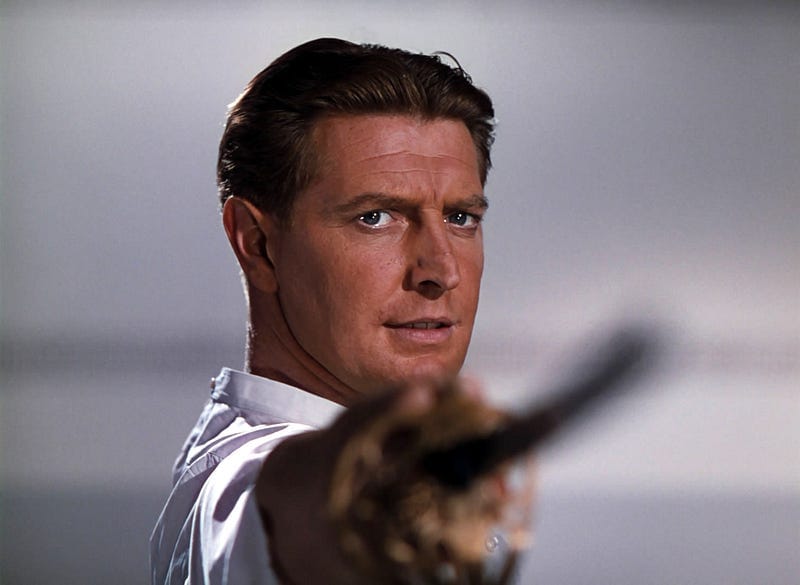
“Pray propose to me the measures necessary to stop this foolish production before it gets any further. I am not prepared to allow propaganda detrimental to the morale of the Army… Who are the people behind it?” — Memo from Prime Minister Winston Churchill to Minister of Information, Brendon Bracken. September 10th, 1942.
Winston Churchill was in the thick of World War II when he was told that The Archers — British filmmakers Michael Powell and Emeric Pressburger — were in production for a film based on David Low’s popular newspaper comic strip Colonel Blimp. Churchill liked the comic — though it had been suggested that the pompous character might be a parody of the Prime Minister himself — and he liked The Archers who had produced some cracking good propaganda films for him: Contraband (1940), 49th Parallel (1941), One of Our Aircraft is Missing (1942). This film, however, was going too far and Churchill wanted it stopped.
To be fair, Churchill was fighting the Nazis and a certain amount of single-mindedness was practical; and The Life and Death of Colonel Blimp (1943) was unlikely to be a one-note film.
Low’s character is fleshed out through the story of forty-years of service from career soldier Clive Candy: as iconically British as they come — the broad comedy, the compassion, the nobility, the “brute force and ruddy ignorance” of it all. And Powell and Pressburger, in this richly textured comedy, make us fall in love with him.
They also insist that he is deeply naïve.
It is this exact contradiction upon which I want to build a case to resurrect The Archers and the cast of The Life and Death of Colonel Blimp for one more film. Not only would I greedily like another example of the joy this film brings me, but also I would like to see what today’s world does when confronted with this particular kind of thoughtful, challenging, work.
To watch Colonel Blimp is to experience both masterful myth making and the deconstruction of those myths happening simultaneously, in stunning Technicolor.
“War starts at midnight, haven’t you been told?”
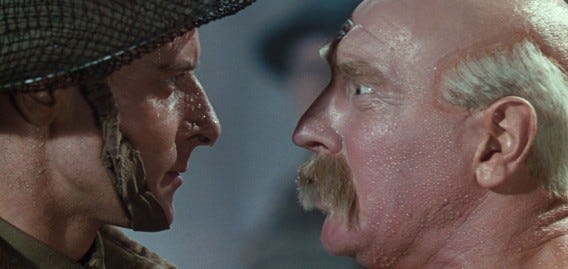
Roger Livesey’s Clive Candy goes from being an impetuous Boer War soldier, cocksure of his and his empire’s place in the world:
“Nurse Erna: I had thought that no one could smoke so much as a German officer, but now I see that a British officer can surpass him.
Candy: And not only in smoking, my dear Nurse Erna… Eating, drinking, making love, growing mustaches.”
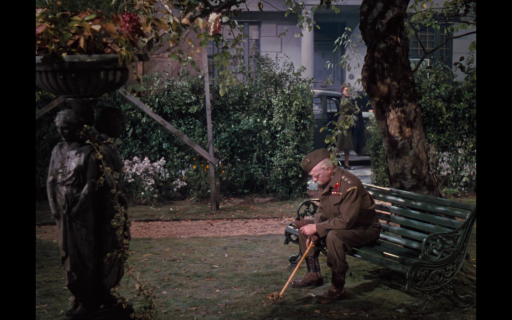
… to an elderly Major-General Wynne-Candy questioning his own worth.
“Candy: Am I dead? Does my knowledge account for nothing? Experience? Skill?”
Along the way, repeatedly, the audience is shown that Candy’s dedication to “good, honest soldiering” and the idea that “right makes might” is of limited use when put to the test. While we might assume that young “Sugar Candy” has achieved some sort of valor in combat, we never see it, nor is it mentioned. He seems to have spent much of his tour in a prison camp singing a single aria from Mignon. Later, during the first World War, we watch him trying to, unsuccessfully, interrogate captured German prisoners by appealing to their sense of honor, only to have a visibly scarred South African camp commander (a cruel visage reminding us not to take Clive’s version of the Boer War as gospel) take a much darker tack after Candy leaves. By the time of the Nazis and World War II, the British government — Churchill’s government — has evidently had enough of his white-gloved moral code and they ignominiously can the Major-General on the eve of a major radio broadcast.
Candy’s story, unlike the comic strip’s own Blimp, is not one of simple buffoonery. The film is extremely funny, but it is also so much more. Clive’s dedication to the attitudes of a Victorian soldier of the British Empire become more entrenched as he moves later into the twentieth century. Contrasting ideals are thrown at him and those contrasting ideals are proven correct. And yet, even those arguing with him cannot help but love the soldier:
“Clive: Wasn’t I just as much of a young fool as he is?
Theo: Yes, but I wonder if he’s going to be such a grand old man as you are?”
“Dear old Clive, this is not a gentleman’s war.”
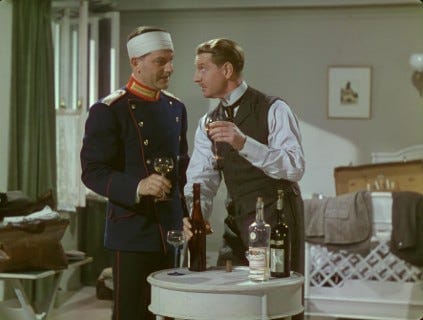
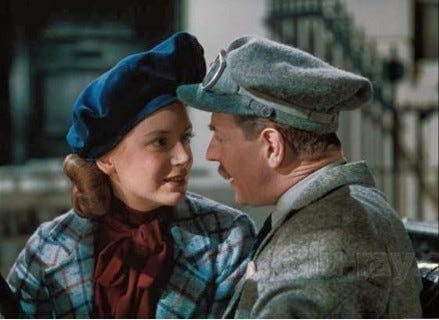
To guide this dirigible past the threatening towers of becoming a farce, Powell and Pressburger have given the Colonel two (or four, depending on how you count it) foils: Anton Walbrook’s Theo Kretschmar-Schuldorff and Deborah Kerr’s polyphonic performance as three different women in Candy’s life.
Kerr’s performances as Edith Hunter, Clive’s first love; Barbara Wynne, Clive’s wife; and Angela “Johnny” Cannon, his driver late in life; all teach us ways, for all his bluster and stubbornness, we might love Candy. Edith, the direct, sharp-tongued, English teacher in Germany, finds the Colonel brave and forthright with a sense of justice. Barbara, a WWI nurse, finds him a sweetly romantic, and occasionally melancholy, lover of tradition. And Johnny, whose boyfriend is attempting to make a fool of Major-General Wynne-Candy, finds him a man of deep, yet antiquated, conviction; something dear — an icon of a simpler time — to be protected.
Kerr brilliantly gives us three women, each just off center of our expectations of the era and we love Candy because we are impressed by them and can’t help but see him through their eyes.
Walbrook’s Theo, on the other hand, represents the opposite to Kerr’s constancy. He challenges the Candy-ness of the Major-General by being someone who started off as much the same man — they met in the most ridiculous anti-duel this side of Barry Lyndon (1975), defending their respective honors — and having the line of his ideological trajectory irreparably broken by the Nazis.
In one of the greatest soliloquies in cinema, Theo explains to the immigration office in London why they should let him — now a refugee from the country he was once willing to die for — into Clive’s England:
“In earlier years, the most important principle in my life used to be never lie. Always tell the truth… Oh I have not told a lie, but I… I also have not told the truth.
A refugee soon learns that there is a big difference between the two.”
This is a submission of a kind that we could never hear from Clive Candy: someone rejecting their country and acknowledging that a bending of honor is sometimes necessary, if needs must.
Kretschmar-Schuldorff’s story, in lesser filmmakers’ hands, is an entire film in itself, but not here. Theo’s story is built to be a rationalist judge of Clive’s:
“Theo: If you preach the rules of the game while they use every foul and filthy trick against you, they’ll laugh at you…
Clive: I heard all that in the last war. They fought foul then, and who won it?
Theo: I don’t think you won it. We lost it, but you lost something, too. You forgot to learn the moral. Because victory was yours, you failed to learn the lesson twenty years ago and now you have to pay the school fees again.”
But for all of Theo’s awakened reason, he, just like Kerr’s characters, loves and protects Clive. He sees goodness in this Blimp, a purity that — once a duelist fighting for Germany’s honor — he will never have again.
Theo also shows us how to embrace Candy, while also warning us not to let him anywhere near our literal battlefield.
“Barbara: That’s a promise: you’ll stay just as you are ‘till the floods come.
Clive: ‘Till the floods come.
Barbara: And this is a lake.
Clive: And this is a lake.”
The Life and Death of Colonel Blimp is a war film without combat, a love story where all the courting takes place off screen, a morality tale with multiple, conflicting, morals. It challenges us to admire honesty and well-meaning tradition in a person while recognizing that the person is a square peg in the endless series of round holes that make up the complexity of modern society. It asks us to define ourselves, but not to be slavishly devoted to that definition.
As a moral statement, the film is almost acrobatic: insisting on holding multiple contradictory ideas simultaneously without sacrificing its thrust.
We are a complex society craving an identity, a version of us that is nobler than we really are. We need the ebullience and surety of a Clive Candy. And we need foils like Theo Kretschmar-Schuldorff to keep our definition honest and to take the rein when that caricature becomes, as it will be more often than not, impracticable.
So let’s resurrect these geniuses and beg them to craft us another dirigible to sail us above our modern day confusion; to help us highlight those pieces of our humanity that mean well and that delight us, and to let those pieces inhabit us for a while.
And then let’s welcome The Archers when they shoot an arrow to pop our balloon as we get too full of ourselves.
One may have wondered how Winston Churchill’s dedication to wartime tunnel-vision endured after finding himself voted out of office before the end of the war he had successfully fought. Might he have seen himself as a Colonel Blimp-type character? After being discarded, as Clive Candy was in the film, suddenly a relic in his own time, did he think back to The Archers’ masterpiece and feel something?
Let’s hope.