How Fast Them Big Trucks Go
Country Truckin’ Music in the 70s
“We were standing on the roof of the world and all we could do is yell, I guess” — Jack Kerouac
Author’s note: This was written around 1998. I have done a limited amount of editing. Be kind to a me from 20+ years ago.
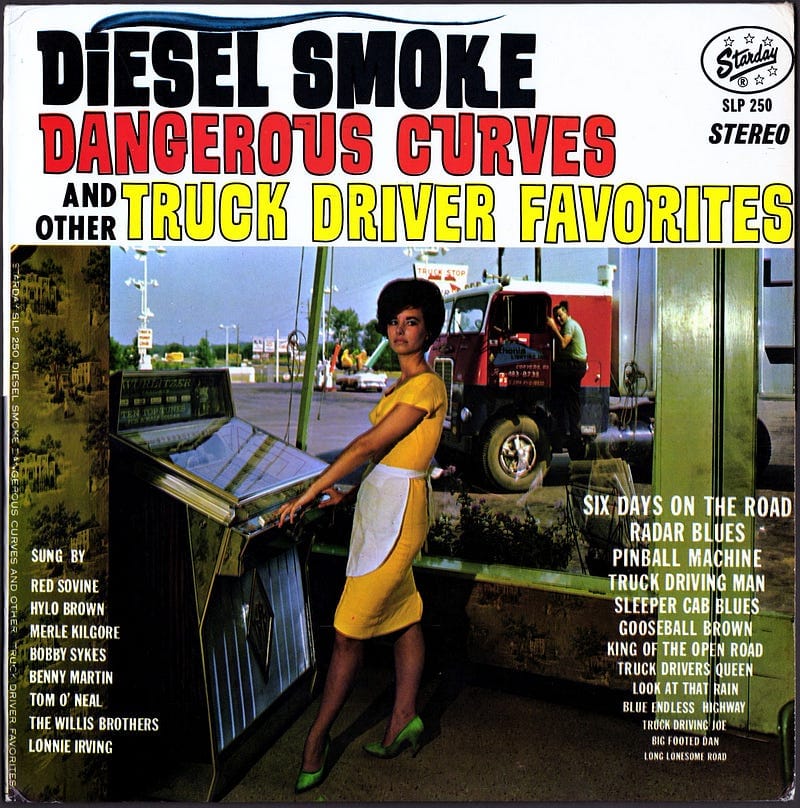
I grew up during the second big wave of the great country Truckin’ movement. This was during the 70s and the voice that was booming into my ears was louder, more rebellious and more violent than that of its 60s country ancestors. Although a good handful of those earlier balladeers resurfaced when the epic 1975 hit Convoy commanded the airwaves for near two years, their tenor had changed. No longer were they lonesome, folksy misfits, unable to reconcile their wanderlust with a desperate need for a family life and home. No, now they were angry. They were rebels, renegades. They battled with the law, often taunting Smokey foolishly just to keep themselves awake. They took drugs, serious drugs, that made them stay up all night and then they sang about it. They saw apparitions in the night and never felt a need to address them as anything less than weighty portents from above. The music was sappy, yes, but filled with such audacity that it was difficult not to be stirred by it.
Growing up, I came to believe that no matter how hard I might fight, it was inevitable that I’d end up either beaten or cruel. The only people in my family who didn’t seem corrupt in some way had been long broken and here were stories, songs and movies about guys who had escaped it all. They were weary sometimes, true, but they NEVER let an innocent be done wrong. They were filled with a desperate longing for physical contact, but their brothers, often only voices across the nighttime sky relayed through their ever-present CB’s were more important than their own lives. Honorable men. Fictional really, but their stories wove a wonderful and immediate lone avenger myth that gave a shy boy a little hope.
Rocket Ships on Rails
According to Country magazine (which, if you’re at the checkout aisle, is the one that looks like a Nashville equivalent of the National Enquirer), a memo was circulated around Capitol Records’ country division which said: “Country music has become dated and to keep up with a modern audience, we must cater to modern issues.” The memo stated that more songs should be written about two income households, corporate jobs, malls despite the fact that, for the first time since the late 50s, country was outselling the pop market.
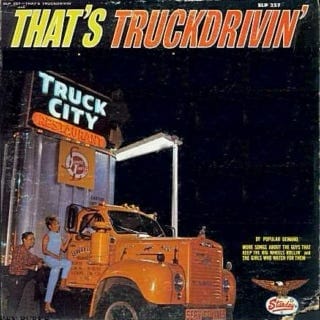
The article continued to debate the virtue of tradition over commercial success, and then the uncredited author made what seemed to be a quiet and unimportant observation: The strategy put forth in the Capitol memo was the exact sort of thing that Nashville had done in the 60s and again in the 70s to revitalize itself. Because the Western frontier ideal of the cowboy and his mount had run its course, the heads of Capitol, RCA, BMI, et al. decided that it was time for country music to hitch up the horses and get into the cab of one of them ol’ “Rocket Ships on Rails,” the mighty 18-wheeler truck! (I take full responsibility for that there exclamation point, good buddy.) With the advent (or invention) of country Truckin’, the nation had suddenly begun to perk up its ears to stories of good ol’ boys who had sought out and found the country’s last frontier, the American Highway. They were lonely like cowboys. They made their own law like cowboys. They had a code, y’know, ’cause they were cowboys. And millions of fans, like myself, found new heroes for an escape from our individual prisons, out on the open road.
The Rise of the Rubber Duck
After the first wave had subsided, the Four Horsemen of country Truckin’: Dave Dudley, Dick Curlass, Red Sovine and Red Simpson seemed to disappear from the country music scene. All of them had been in the Top Ten Country (and often the Pop charts) consistently, but suddenly they found themselves losing their piece of the public imagination. Far from being perceived as a tragedy, however, for the most part the four seemed to be relieved to have been allowed to walk away from the fad they had been asked by their record companies to create. Dave “6 Days on the Road” Dudley, in particular seemed happy to move back into the country ballads that he loved to write and sing. But they were not to get off so easy and after a few years away they returned to the well-furrowed ground that had made them so successful. Curlass was first back into the pot with his top 100 charting, Big Wheel Cannonball. Simpson hit top 10 with his truly odd, I’m a Truck. And even ol’ reticent Dudley came back in 1973 with Keep On Truckin’. (Dudley’s career extended across the pond to Europe in the 80s after a West German band called Truck Stop had a minor hit with a tune called Ich möcht’ so gern Dave Dudley hör’n (I Want to Hear More Dave Dudley.)
But if these boys found themselves surprised that they could still make a living singing about life in the cab, they could never have predicted what was steaming up out of Wolf Creek Pass next:
Was the dark of the moon on the sixth of June and Kenworth pullin’ logs.
Cab over pete with a reefer on
And a jimmy haulin’ hogs.
We was headin’ for on I-one-oh ‘bout a mile outta Shakytown.
I says ‘Pigpen this here’s the Rubber Duck
And I’m about to put the hammer down!’
Now THIS was some epic stuff for a kid! I still get a thrill out of those lines today. Out of a blur of CB chatter and static (I was never sure if I could separate the two), comes this enormous voice. I’m still not sure what it all means, but the experience was like that baffling beautiful first taste of Chaucer, the first time you actually savored those medieval phonemes crossing your vocal cords. What the hell is a “Cab over pete with a reefer on”? Who cares! Just say it with me a few times. It’ll do you good.
And so goes C.W. McCall’s, Convoy, not only the biggest hit of the genre, but also one of the biggest hits of the 70s. For the first time I was hearing the actual sound of the cowboy on the trail. It’s as if Roy Rogers didn’t wait for the campfire to start singing; gun in one hand, guitar in the other and he’s yodeling along WITH the gunfight. The patter off of CB’s, strangely ignored in Truckin’ music until 1975, was suddenly our mainline into the highway bloodstream of America. No longer did we feel like we were getting rehashed and distorted secondhand stories from the Lone Prair-ee. The immediacy was so shocking and vicarious, how could you not get wrapped up in it? Our heroes were redefined and we found them lively, funny and pure.
There are two profoundly interesting things about the man responsible for Convoy. The first is that on the weight of a single song he was one of the most successful men in the music industry over that decade. The second is that, in spite of recording over ten full-length albums, making numerous TV appearances and hundreds of interviews, C.W. McCall has never actually existed.
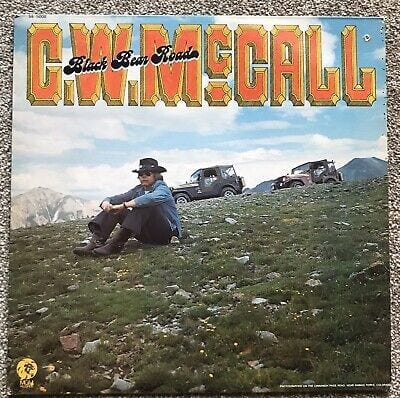
The man who created (or perhaps simply became, it’s hard to tell) The Rubber Duck, was a fictional commercial creation, not unlike Sigue Sigue Sputnik, or Ernest. Here’s how it worked… In 1972 a 45 year old Omaha advertising executive named Bill Fries had to work up a campaign for his clients, Metz Baking Company and their delicious “Old Home Bread.” The campaign involved radio spots featuring Fries himself as a trucker who delivered for the local bread kingpin and were centered, mostly, around his conversations with his girlfriend, Mavis, at the “Old Home Filler-Up And Keep-On-A-Truckin’ Cafe” where she worked as a waitress. The ads were so successful that they were soon being filmed for television and, when they had become so popular that local TV stations had to announce schedules of when they would be shown in order to cut down on the constant telephone requests, Nashville decided that Fries was a man worth paying attention to. After a quickie local record, MGM decided that this unlikely fictional star needed to be introduced to the rest of the world and “C.W. McCall” recorded the predictable single, Old Home Filler-Up And Keep-On-A-Truckin’ Cafe which hit #19 on the country charts. The corresponding album, Wolf Creek Pass was reasonably successful as well and Fries suddenly found that his bread-delivering brainchild was about to become a star. He quit his job and, wrapped in the skin of his creation, went into the studio and changed everything.
Chip Davis is a name that you may not be overly familiar with, but what he hath wrought is imminently recognizable. By the time of McCall’s second record, Black Bear Road, Fries had formed a stable backing band centered around his friend Davis, and they began working on what would be one of the most elaborately (and bizarrely) orchestrated country music tracks ever recorded. Davis, it turns out, was using this time to not only help out his friend, Fries, but to learn his way around the studio and get his band geared up for his own projects, Fresh Aire and the uber-successful Mannheim Steamroller. He was, through a totally unlikely genre, refining a delicate new age sensibility to his music. Soon, Davis was to become the undisputed king of “spiritual” orchestral music, but we must never forget that he learned his craft from the cab of a truck.
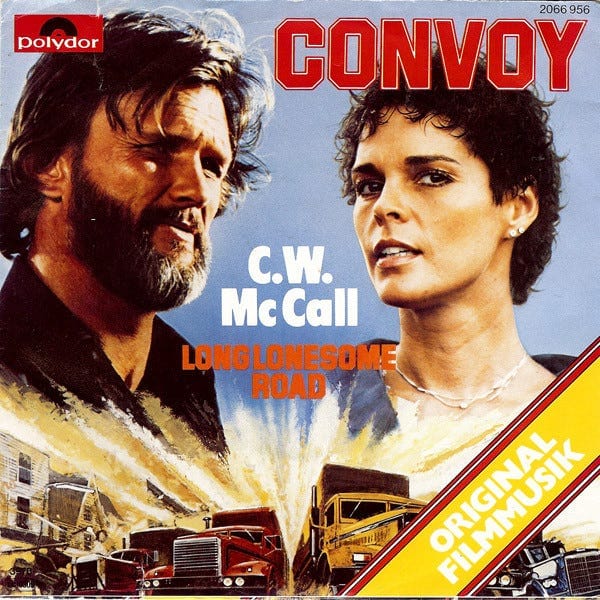
Convoy was as unstoppable as the Rubber Duck’s epic trip across the country from “Shakytown” (Los Angeles) to the Jersey Shore. Every time it looked like the song would peter out, it would seemingly gain new life and climb right back up the country AND Pop charts. Fries’ outrageous story about a trucker pulling together a massive train of vehicles all united on keeping that damn Smoky Bear out of their hair as they cross the country, just seemed to strike exactly the right chord at the moment. This was the Vietnam era, when the government had found a new strategy of governance: basically straight up lying to the people, and then ignoring any sort of guilt that might come with being caught. Whether pro- or anti-Vietnam, we found ourselves knowing the wisdom of mistrusting our government. Pigpen and Rubber Duck (along with 1000 Screaming Trucks, Sodbuster, the Suicide Jockey, Eleven Long-Haired Friends of Jesus and a Bullet-Proof Microbus) gave us an enemy representative for a government that was (among other things) wasting its time prosecuting honest, hard-working Americans with an over-inflated legal system. Sheriffs, highway patrols and police were all dubbed “Smokey Bear” (named for their hats: a fashion statement they shared with the Forest Service’s favorite bear). The Truckers never did anything malicious. They did what they needed to do to get their jobs done. And if that meant sending Smokey on a wild goose chase, or busting through a “roadblock on the clover leaf,” then so be it. What was right would just have to take what was legal and dump it on its ass.
The impact of Convoy spread not only across the radio, but throughout Americana. The CB Craze took hold of music, books, and especially movies. Master director Sam Peckinpah took responsibility for the Duck himself in his 1978 film Convoy, and in a brilliant move, cast Kris Kristofferson as America’s newest John Henry. While the film might have made Fries’ McCall’s creation a little more human and frail than the public was expecting, it showed us the breadth of this idea that we had grabbed hold of in 1975 and were showing no signs of letting go.
And speaking of movies…
Enter: The Snowman
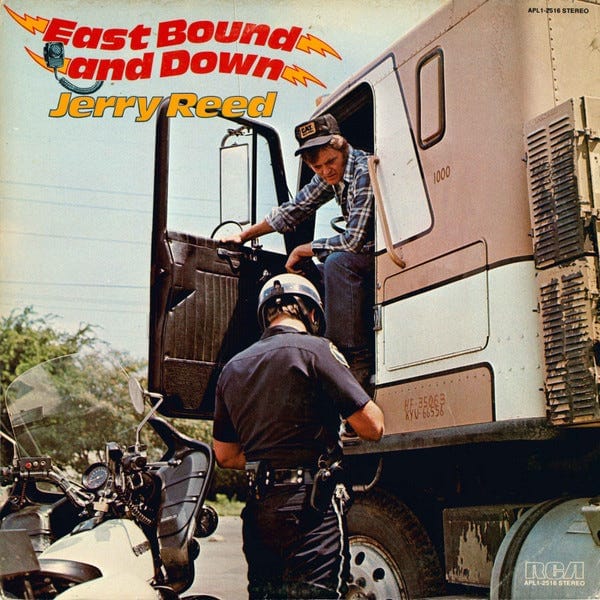
Easily the best musician of the whole movement, Jerry Reed is sometimes described as having been pigeonholed by the Smokey and the Bandit movies and his corresponding hit, Eastbound and Down. But Reed himself doesn’t see it that way. He is so proud of his work in the Smokey movies he often still signs his notes and letters “The Snowman”, his character in the film. While his actual songs about Truckin’ are limited to his themes from the first two of the films, Eastbound… and Texas Bound and Flyin’. he is so strong of an icon in that movement that you just can’t ignore him.
Reed, after a stint in the military, rolled into Nashville in the early ’60s in an overloaded poultry truck to try his hand as a country picker. It wasn’t long until he had got a few songs recorded by other artists and the master, Chet Atkins, had started eyeing the boy as something of a protege. Sliding neatly into a new group of young articulate country songwriters, Reed was able, with Atkins’ help as producer and mentor, to start making some well-received records and even have his brilliant Guitar Man recorded by Elvis.
This period establishes Jerry as a respectable and extraordinarily talented force in country music… but that’s not the Jerry Reed we’re after. The Jerry Reed we’re looking for starts to appear in the early 70s as a regular on Glen Campbell’s popular TV variety show and later The Jerry Reed When You’re Hot You’re Hot Hour. It’s as we began to get a glimpse of Jerry as a personality on top of his always-brilliant musicianship that we find an emerging kind of southern star. By this time Reed had thrown out the Country Music Rulebook and was making it up as he went along. His influences ranged from raunchy southern trash backyard pickin’ to a real nasty layer of guitar funk. He was exuberant, unorthodox and totally irrepressible (still is, in fact). There was a challenge that permeated his music to lay down your preconceptions about genre or get the heck out of the way. This was the kind of hero that Bill Fries and Chip Davis had fabricated, but Reed was for real.
Burt Reynolds instinctively recognized in Reed not a foil, but a rowdy, likeable and, most importantly, authentic partner. Giving him a role in the Reynolds-directed Gator proved that Jerry had the stuff, and in spades. While the sequel to White Lightening might not have been as successful, or frankly as good, as its predecessor, they had set up some groundwork for what was to prove their most successful film together, a little film about a trucker, a sheriff, a girl and her Bandit.
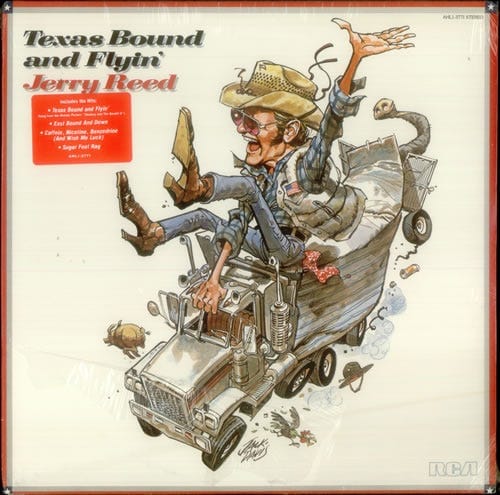
Smokey and the Bandit gave us the Reed that we most treasure today. He’s a hound dog lovin’, drinkin’, laughin’, pickin’ ol’ Southern boy who calls EVERYBODY “Clyde.” This Jerry Reed is that redneck uncle of my family and many other families I had met growing up in Texas. The key here was that Reed was not only 100% Southern, but he was also heroic.
It is hard to imagine, unless you are a Texan or Southern transplant, how sneeringly your childhood can be insulted, openly and with revolting righteousness. Well Jerry Reed ain’t Hee-Haw and neither am I. When Reed got in that truck to help Burt Reynolds make that crazy-ass beer run across the country, people from New York City to San Francisco cheered those ol’ boys on. A lot of us southern folk knew someone like Cledus The Snowman in our brothers, our dads or ourselves; and we wondered if the country was going to give us a break, too. When Reed had a major commercial hit with the theme song, Eastbound and Down, and people started to listen to his other music (When You’re Hot You’re Hot, Amos Moses, his cover of Tex Williams’ classic Downtown Poker Club, even his theme to Hot Stuff) our hopes soared even higher that the rest of the country might actually be willing to accept that we have a real culture down here.
Coors, Cocaine and the Kid
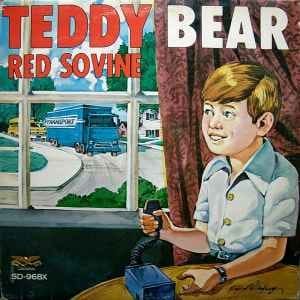
Red Sovine reached number one with a bizarre song about a child who can’t walk and is the son of a dead truck driver. More a narration with music than a song, Teddy Bear is a calculated tearjerker that shouldn’t work, but does. That about sums up Sovine’s career. Sovine’s voice is a little on the weak side for singing, though as a narrator there is an honest, aching quality that dares you to laugh at the sappy nonsense he’s delivering. It’s a challenge I have folded under every single time.
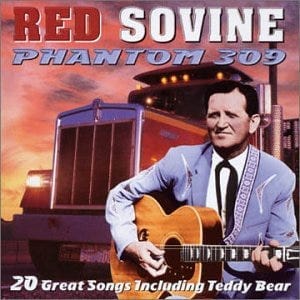
Roses for Mama involves a little boy asking a trucker to loan him money for his mother’s birthday. The Trucker, being a trucker, is glad to, especially since it’s HIS mother’s birthday as well. But wait, there’s a twist, and every time I hear it, including just now, I tear up. Go listen to it yourself; I’d hate to spoil the thing. Phantom 309 (later covered by Tom Waits) has a hitchhiker being picked up by the late Big Joe in his Flying Dutchman-like truck. Colorado Kool-Aid is about Sovine’s Mexican friend hacking another fella’s ear off. (Of course they all have a good laugh about it afterwards.) Last Goodbye finds an apparition of a man’s just dead wife coming to visit him before she moves on to the afterlife.
Sovine seems to have no boundaries… Drug addiction? Sure! Vietnam? Well all right! And death, death and more death! The point is that Sovine, who is the most traditional-sounding of all of these artists, has somehow managed to create an insane miasma of death and phantoms and visions born out of suffering, and not only did no one bat an eyelid, but they rewarded him with hit after hit after hit. Even more so than Dave Dudley, Sovine’s country Truckin’ career made the transition into the 70s successfully by simply adding the CB element and then getting weirder. What, I think, makes him so compelling, is that Sovine himself doesn’t seem to understand just how strange a world where Elvis plays a 24-hour concert on the back of a flatbed several hours AFTER he died ought to be. He is completely committed to his subject matter. You can’t dismiss him because he is a man of miraculous faith in his own lyrical content. In fact, Sovine believed so strongly in his characters that when someone suggested he do a song wherein Teddy Bear finally died, Sovine refused to record it, and when Martina McBride did, he countered with a song in which not only was the little crippled boy alive, but he gets a puppy.
Sovine is a treasure in American culture. Like Johnny Cash, he’s a staunch traditionalist without having to plow the traditionalists’ ever shrinking topical field. It was hard for Nashville to really know what to do with Sovine. Having been friends with both Hank Williams and Elvis Presley and actually having replaced Williams when the Grand Ole Opry had to kick him out due to his drunkenness, Sovine has earned a certain resigned respectability from the country music community. There are, however, no serious collections of his catalog which spans from the ’40s to the ’80s and includes hits from almost every style of country music that came along. There is no Country Music Network retrospective of him while there are several about other acts who were FAR less successful. No one, barring the aforementioned Tom Waits, covers his songs and if country music as a whole had any guts left, they’d admit that they were embarrassed by him. But modern country music is stupid and cowardly and they don’t understand what’s wonderful about Red Sovine.
Yeah, it’s true that a large hunk of his most successful recordings border on the ridiculous, but they almost always stay on the right side of that border and a man who can spin stories this outrageous with such absolute conviction is a valuable friend on the road… or to someone who dreams of the road.
The End of the Line
In the mid-1980s the trucking industry was deregulated by that bastard Reagan (who, ironically, swept to political power on a wave of anti-government sentiment). Soon these last cowboys began to break. Their jobs were no longer considered skilled and their wages were regulated by whim. Trucking companies became favorite buys in junk bond deals and salary reduction contracts became commonplace as did the inevitable human liquidation that follows. If the call to the road in the 70s was romanticized and partly fictitious, the pluck and determination, the sheer resistance to the whims of any part of society besides the one that they themselves had built was very real and very inspiring. If it took more than a few pop and country hits, movies and TV Shows to give us at least some idea of the possibility of a proud and intrinsically American lifestyle, then let’s praise that. Let’s praise rebellion over cynicism and loyalty over style. Let’s think about this movement which we seem so quick to ridicule.
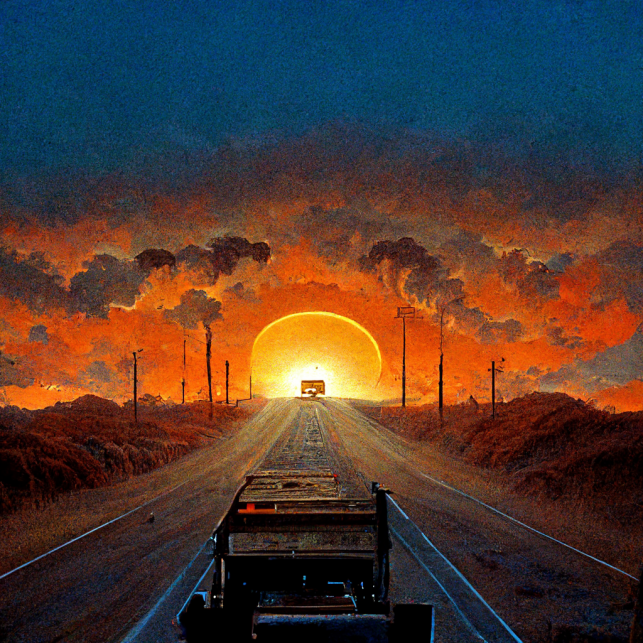
I still occasionally see this image, my truck parked outside a choke-and-puke in rural Alabama or Tennessee or Texas. I’m wiping the mustard stain off my mouth with a napkin as I yell goodbye to all my good buddies inside. I’ve got a deadline to make and I’m a little worried about some weather up about 100 miles north. I crawl up into the cab and fire the thing up taking a look out over the flatland ahead.
The sun’s going down and you gotta respect that, because the American dusk just ain’t something you screw with.