A Salute to Attractions The Disney Parks Never Should Have Closed (But Mostly Muppet*Vision 3D)
The closing of a masterpiece leaves us thinking about earlier retired attractions.

I am not naive. I understand that a new attraction brings a burst of increased revenue for a time, though I would argue that eroding the thematic consistency of the parks causes significant long-term loss that might counter some of that short-term gain. I also understand that some attractions can lose relevance, or may have been ill-conceived to start with. (No one is mourning the Phantom Boats.) The parks DO have to innovate and grow.
I get it.
But Disney as a company is not always clear-eyed about the attractions that form the foundation of their own parks’ greatness, and sometimes they might find their heads a little in front of their skis in their ambition to keep ahead of the competition.
With this week’s closure of Muppet*Vision 3D, it seemed worth a few minutes to consider some other attractions that the Disney parks might have made a mistake in shuttering. Here’s a tidy list of my top ten.
Adventure Thru Inner Space (Disneyland 1967)
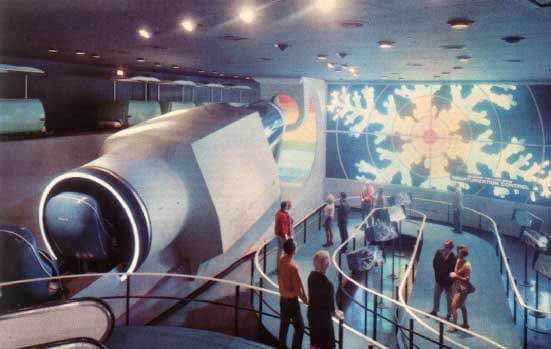
Yes, it needed a serious updating, and yes, it was replaced by the wonderful Star Tours (1987), but Inner Space added a depth to Disneyland’s Tomorrowland that it no longer has. Star Tours, in contrast, while a delightful ride, added an ill-fitting bit of intellectual property.
Recently on our podcast, I suggested that what Tomorrowland needed was its own Haunted Mansion (1969) — something that might get under your skin a little bit and have some weight to it. Adventure Thru Inner Space was that. Scientific, mysterious, and existential, its story of a shrinking experiment gone wrong — with the same ride vehicles and the same narrator as The Haunted Mansion — had a tone that no other theme park ride ever has replicated.
Disney should never have taken out something this completely unique.
Horizons (EPCOT 1983)
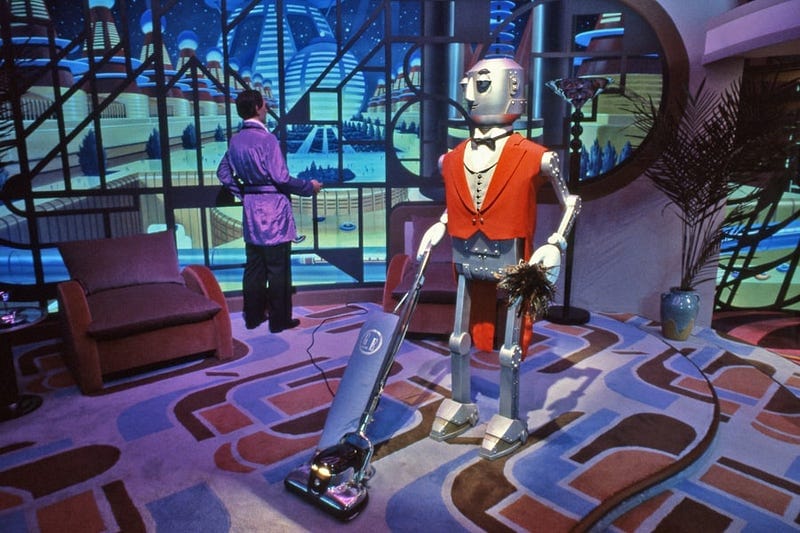
The story here is much the same as Inner Space. It needed updating, many parts needed a complete rebuild, but where it differs from the Inner Space story is that it did not even get a cool replacement. (The fact that as roundly disliked an attraction as Mission: Space (2003) has outlived Horizons boggles the mind.)
More than any other Disney park, EPCOT has suffered a dissolution of its core attractions. The area formerly known as Future World has only four attractions left from the first decade of the park, and two of them (Journey into Imagination (1983) and The Living Seas (1986)) are shells of their former selves.
None of the fallen are quite as intensely mourned as Horizons.
Horizons was a fifteen-minute-long science fiction journey that managed to bring both 2001: A Space Odyssey (1968) grandeur, through the use of massive sets and IMAX screens, and a sense of nostalgia with its references to Jules Verne and, even, Disney’s own Carousel of Progress (1964).
In many ways, Horizons was a kitchen-sink kind of ride, with a flood of fascinating and original ideas being crammed into it, but, by the end of the experience, the important thing was that you felt like you had lived in an optimistic future where your own family would be welcome.
It was a marvel.
The Great Movie Ride (Disney’s Hollywood Studios 1989)
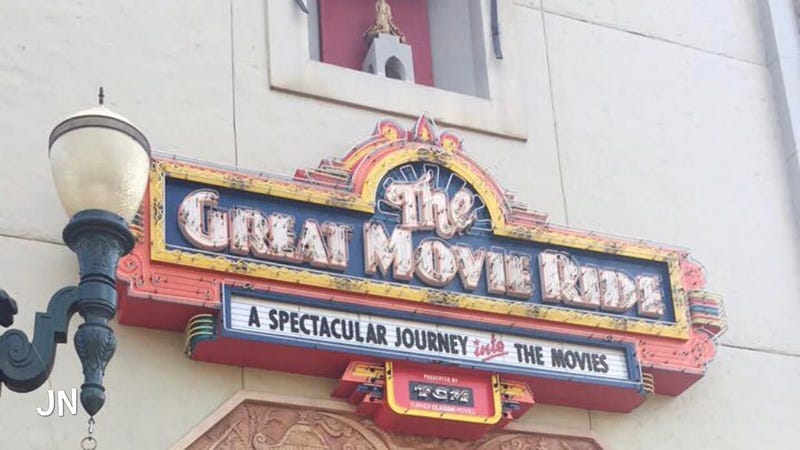
No question, we all love Mickey and Minnie’s Runaway Railway (2020), but there is something almost masochistic about removing the centerpiece attraction of a whole park! It’s a little like removing Spaceship Earth (1982) from EPCOT or Sleeping Beauty Castle (1955) from Disneyland.
I am going to stop saying that these attractions needed updating, because, of course, they do: Pirates of the Caribbean (1967) needs updates sometimes, too. That should not dissuade Disney if the ride is this important to a park’s identity.
The Great Movie Ride was REALLY important to Hollywood Studios’ identity.
It was also a wonderful and nostalgic trip through a special kind of Americana: our history through film. In some ways, it felt like the most patriotic attraction in the whole of Walt Disney World, even after considering The American Adventure (1982) and The Hall of Presidents (1971).
The park has struggled with its thematic purpose without it.
The Mickey Mouse Review (Magic Kingdom 1971/Tokyo Disneyland 1983)
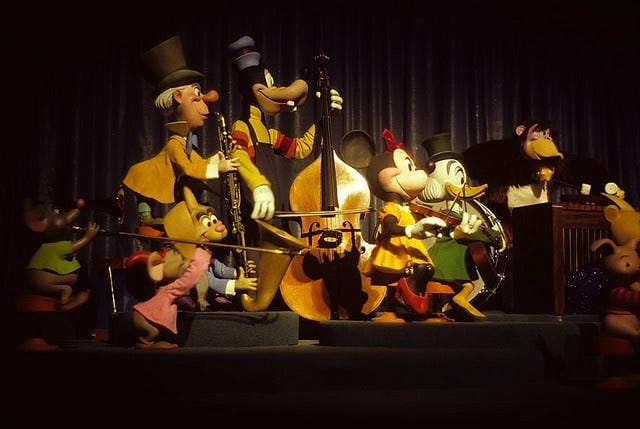
This was an odd little show, but it filled some noticeable gaps at the Disney parks. It tied together a bunch of disparate Disney characters and gave a sense of a real pantheon; the Three Little Pigs and Jose Carioca and Donald Duck seemed to coalesce into one coherent Disney family. More importantly, though, the show gave a real focus to the great early-twentieth-century Disney songs that a guest would otherwise only hear in the background during their park day.
It was a celebration of the roots of the Disney Company’s greatness. It was also extremely cleverly staged, with the admittedly limited, small audio-animatronic figures managing to evoke a coherent story that had a sense of what the Disney company had really been about all these years. It used the characters, music, filmic techniques, and elements of shadow puppetry to build its narrative.
The loss of the Review, transferred to Tokyo and then retired in 2009, left very little connective tissue holding the early shorts and features together as any sort of mythology. There were the Storybookland Canal Boats (1955), still going strong in Disneyland, and a few odds and ends of more modernized versions of Mickey, Minnie, and the core gang… and that’s it. (While I love Toontown, that is Roger’s world. Mickey just lives in it.)
And there is nothing left that celebrates that pre-fifties music with as much sincerity and affection.
The Golden Horseshoe Revue (Disneyland 1955)
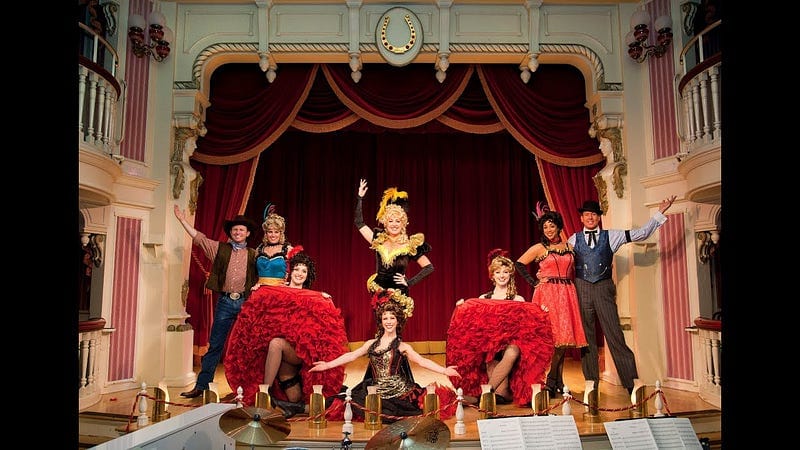
Frontierland is a tricky proposition these days. While it never had much to do with the reality of the American west (as I discussed here), it did recreate a mythology — a particularly filmic mythology — pretty well. Now, much like Disneyland’s Tomorrowland, its identity has begun to fray.
When you are standing at the Rivers of America between the docks and the restaurants, what do you feel like you’re looking at? My guess is that, for most people these days, it looks like a path to New Orleans Square or Batuu, not at an environment that holds its own.
The Golden Horseshoe Revue — the show that occupied The Golden Horseshoe Restaurant for over thirty years — was the anchor that turned that thoroughfare from a place that guests simply passed through to a lively and immersive theme park land. The show was a crowd-pleaser that would often spread out onto the streets of Frontierland as Wally Boag would occasionally take his Pecos Bill character out of the confines of the Horseshoe and into the passing throng for fake gunfights or other shenanigans.
It is hard to say why the show, which sold out consistently and inspired such performers as Steve Martin to take on comedy, was canned. Disney has had a love/hate relationship with its live performers for some time now, and the history of the Golden Horseshoe has been one of progressively smaller, less elaborate shows ever since the Revue left.
Today, the stage is mostly left bare.
Skyway (Disneyland 1956/Magic Kingdom 1971/Tokyo Disneyland 1983)
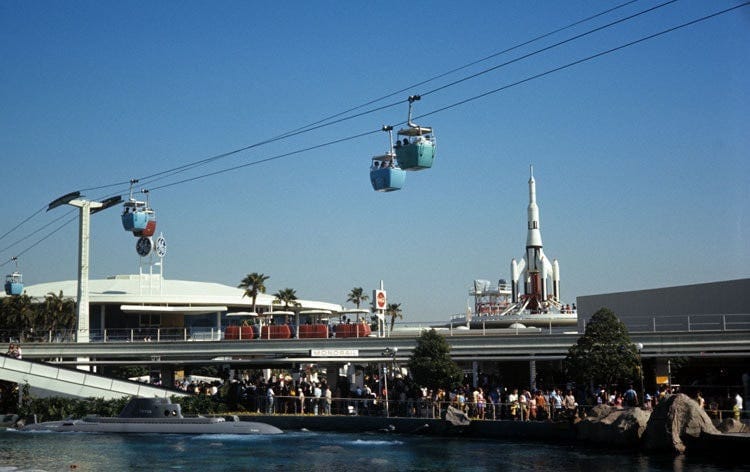
There was a time, friends, when everywhere you looked in Disneyland’s Tomorrowland, something was in motion. There were Submarines, Autopia (1955) cars, the PeopleMover (1967), the Monorail (1959), and, high above them all, the Skyway that would take people from Tomorrowland to Fantasyland and vice versa.
The visual dynamics were important, as was the idea that one could get into a bucket with a few members of your family or friends and ride peacefully above the crowd for a little while. It was quiet and serene, and, as it threaded the needle of the Matterhorn (1959), one of the more unique views in the park.
The reason for the closure of the Fantasyland-Tomorrowland Skyway in Disneyland (as well as the one in Florida’s Magic Kingdom) has been a source of some controversy for years, but, as is usually the case with these things, the answer is probably more a collection of reasons — repair work on the Matterhorn, decreased ridership/increased maintenance costs, Imagineer concerns about seeing the un-themed tops of buildings, needs for additional funding for the soon-to-open Indiana Jones Adventure (1995) — but whatever the reasons, one of the Disneyland’s few quiet rides with one of its most unique views is gone.
WEDWay Peoplemover (Disneyland 1967)

Yes, there is a PeopleMover still in play at Walt Disney World’s Magic Kingdom. I’m aware. There are some notable differences between the two.
The Florida attraction uses a different propulsion system that allows for changes in speed but not elevation, and thus the steady, loping progress that the California ride had is replaced by something a little more… speedy (and occasionally turbulent). Also, the sense of the original WEDWay PeopleMover as a real mode of public transportation is replaced in Florida with something that acts more like a ride with a narrative.
No shade, they’re just different.

Most everything I said about the Skyway is also true here: visual dynamism, quiet serenity, rare views… But while there are sky bucket-style attractions at a lot of parks, the PeopleMover was completely unique. It was a vision for the future (and, yeah, in some ways it was a suggestion that took hold as there are PeopleMover-type transportation systems being used here and there in the real world).
This attraction was a key element to the 1967 Tomorrowland renovation, often known as “The World on the Move.” This was the most perfect Tomorrowland (a hill I will die on) and the WEDWay PeopleMover was an integral part of it. Now Tomorrowland looks almost completely static with its IP-drenched attractions all being housed inside buildings.
The reasons for its closure are as complicated, if not more so, than those for the Skyway: declining ridership, decaying infrastructure, and a desire to invest elsewhere in the park. Whatever the cause, our eyes crave that motion that Tomorrowland used to have. We have a need to see a future, a positive future, on the move, thriving once again.
Also, bring back the original Tron attraction: the Peoplemover’s trip through the Game Grid!
Adventurers Club (Pleasure Island 1989)

Okay, I know Pleasure Island wasn’t a theme park, but for about fifteen years it was an integral part of many people’s Walt Disney World vacations.
Was the complex 100% successful as an adult nightlife venue? No. Does it have a legacy? Boy howdy! And that legacy is the Adventurers Club!
Though Fortress Explorations in Tokyo Disneyland is the first time that the S.E.A. (Society of Explorers and Adventurers) name is invoked, the antecedent — its urtext — is Adventurers Club. Artifacts from the club are spread throughout all the S.E.A. installations at Disney parks across the world, and the characters that populated the club have appeared in S.E.A. propaganda throughout the Disney parks.
S.E.A., the mythology that Disney has been desperately trying to turn into a “thing”, starts here.
But this is not the main reason why I think the club should still be around. Adventurers Club was a giddy distillation of some of Walt Disney’s brightest mid-century dreams.
Utilizing actors, animatronics, special effects, and the stunning environmental work of Imagineer Joe Rohde and his team, the club managed to be both sweepingly dramatic and strangely intimate. One minute you could be singing songs and chanting slogans with a bar full of guests and character performers, trying to keep the gods from returning to give everyone unfortunate haircuts (no, really), and the next get invited into a small back room where a ghost piano player is hosting a recital. Walt’s ideas about taking an individual or small group and having them feel like they were in a movie? It happened right here!
This place made you feel special, like you were part of something bigger — an important part.
The Adventurers Club was closed along with most of the other themed venues on the not-quite-well-enough-thought-out Pleasure Island. The space is now occupied by part of the Disney Springs shopping area.
If any piece of Pleasure Island deserved to be saved, or moved to a different location (Animal Kingdom, anyone?), it was the long lamented Adventurers Club.
One-of-a-Kind Shop (Disneyland)

I hear you now, “Are you crazy? This is a shop. It’s not an attraction.”
But indeed it was an attraction, one that many guests made a particular point to visit, often coming to the park just because they had heard a particular antique they were interested in was there.
Disneyland, for a long time, prided itself on being an experience unlike any other. In some ways, it still is, but in others, it has given way to marketing trends from outside its berm. This cannot be better seen than in the demise of a place like New Orleans Square’s One-of-a-Kind Shop.
The little store was something of a gift from Walt Disney to his wife Lillian, who loved antiquing. The place was filled to the rafters with wonderful and odd pieces bought by Cast Member Hildegard Webster, who traveled around collecting things for the store. There were occasional reproductions of rare items, mostly for larger pieces like chandeliers, but for the most part, everything was a unique and original piece. The prices were not only reasonable, but occasionally a steal.
With the loss of places like the One-of-a-Kind Shop, Disneyland gets a little less unique. It is work ill-suited to a large corporation, maintaining a single store with needs that are particular, but those are exactly the kinds of things that make Disneyland special.
Main Street’s Penny Arcade no longer hosts antique games. The Emporium has the same wares as a Disney Store in Dubuque. The Magic Shop sells gags like you would find in a Spencer’s Gifts. And the One-of-a-Kind Shop is gone forever.
Muppet*Vision 3D (Disney Hollywood Studios 1991/Disney California Adventure 2001)

Some theme park attractions are so well thought out, so brilliantly executed, that they should be considered works of art. The Haunted Mansion, Pirates of the Caribbean, and The Enchanted Tiki Room (1963) are amongst those.
And so does Muppet*Vision 3D.
The final work of one of the twentieth century’s finest artists, Jim Henson, Muppet*Vision seems to serve as a finale to his career. It’s a deft manipulation of all of the comedic styles and puppetry skills he’d mastered, held together with one of the most sure-handed uses of theme park technologies ever collaged together.
Take a minute and think about what Henson did with how he combined puppets, film, animatronics, special effects, and live performers in a way that had all the elements working towards a unified goal. We complain about the overuse of screens in theme parks these days, but not here. If you want your heart to ache, think about how differently theme parks would look today if Henson had kept designing for them; if we had not lost him so young.
Not only is the attraction’s retirement an incalculable loss in terms of art (and my colleague Zach’s article says it better than I do), but, to add insult to injury, the attraction is being replaced with… nothing. The area will be re-themed to Monstropolis to jibe with the new Monsters, Inc. roller coaster being installed, but the coaster is not slotted to use that building at all. If Hollywood Studios were a more strictly themed park, I could understand the concern with the mismatched themes, but I refer you back to The Great Movie Ride above. It’s a hodge-podge of themes already… unless you think Aerosmith was a good compliment to The Twilight Zone.

So that is my list: ten things that the Disney parks should not have let go. Perhaps I’m too nostalgic for a Disney that is no longer realistic in today’s world, but I am okay with that.
What about you? What attractions do you think they should have kept? Which ones do you miss the most?
Let us know!
Enjoy this story? Check out our podcast!

And all things Kelly, https://bio.site/kelly.mccubbin
Be sure to follow Boardwalk Times for more coverage of The Walt Disney Company.
Support Boardwalk Times on Ko-Fi.
Support Boardwalk Times by visiting Boardwalk Store:

If you like this article. Subscribe to our free newsletter Boardwalk Times: Stories from the Seashore, a monthly dose of Disney and its businesses.

Kelly McCubbin is a columnist for Boardwalk Times